
Contact Us
How to Choose Ceramic Dental Restorations for Your Clinic
Choosing Ceramic dental restorations is not simply a matter of selecting the whitest crown. It requires clinical judgment, material knowledge, and careful communication with patients. The restoration must fit the tooth, occlusion, preparation design, laboratory workflow, and patient expectations.
Market reports show strong commercial growth. Grand View Research estimated the global dental ceramics market at approximately USD 7.5 billion in 2023. Its report also projects continued growth through 2030. However, market size does not prove clinical superiority. Definitions vary between reports, and promotional claims can hide important limitations. That deserves attention.
Clinical evidence offers a more useful direction. A systematic review in the Journal of Dental Research reported five-year survival of approximately 90.7% for all-ceramic single crowns. Outcomes differed by ceramic type, tooth location, bonding protocol, and study design. Zirconia, lithium disilicate, and layered ceramics should not be treated as interchangeable materials. They behave differently under stress.
Dr. Markus Blatz, a recognized specialist in esthetic and restorative dentistry, has emphasized a practical principle: “The best material is the one that suits the clinical situation.” That sentence remains highly relevant. A posterior molar with heavy bruxism needs a different risk assessment than a thin anterior veneer. Shade matching also involves lighting, stump color, translucency, and laboratory communication. Small details matter.
This guide examines strength, esthetics, preparation requirements, cementation, repairability, cost, and maintenance. It also questions a common assumption: newer does not always mean better. Dentists should compare independent evidence, manufacturer data, and real clinical experience before changing their restorative protocol.
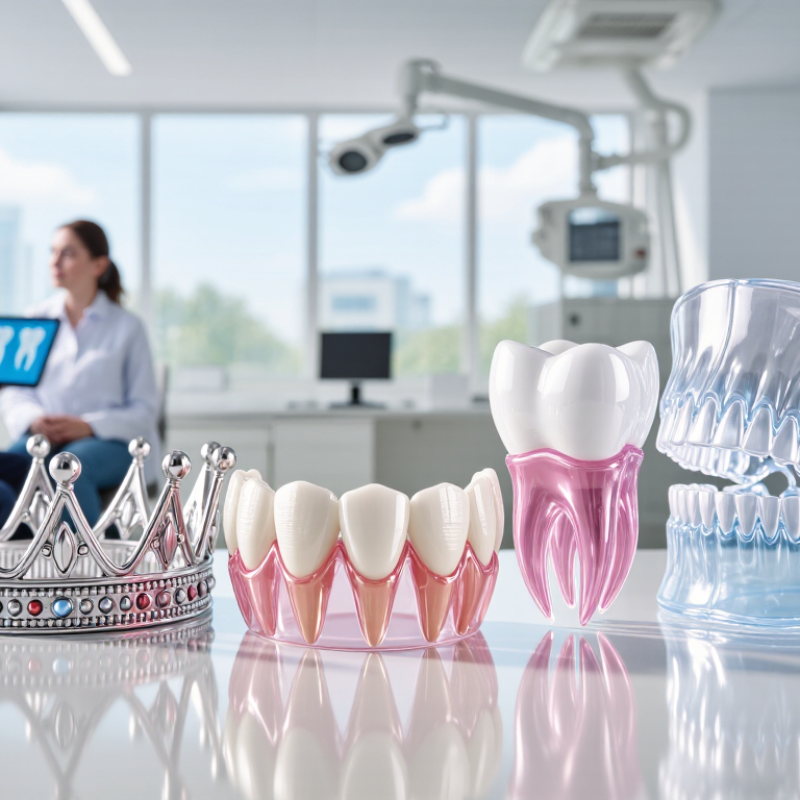
Define Clinical Requirements and Patient Needs
Choosing ceramic dental restorations begins with a clear clinical assessment, not a material preference. Examine occlusion, remaining tooth structure, margin position, and moisture control. Intraoral photographs and radiographs can reveal risks that a quick visual check misses. A heavily damaged molar may need strength more than exceptional translucency. An anterior veneer demands different priorities.
Patient needs also shape the decision. Ask about appearance, chewing habits, sensitivity, appointment tolerance, and budget. A patient who grinds at night may require occlusal protection and a more cautious restorative plan. Someone with limited dexterity may need contours that support easier cleaning. Discuss shade, expected longevity, maintenance, and possible repairs in plain language. Consent should reflect realistic outcomes, not perfect promises.
Clinical experience has taught me that shade selection is less predictable than it appears. Lighting, dehydration, and nearby restorations can change perception. I prefer assessing shade before isolation and recording the conditions used. Still, this method is not flawless. Patient expectations can shift after treatment, especially when photographs create unrealistic comparisons. Review parafunctional habits and periodontal health before finalizing the design. If the clinical information is incomplete, delay the decision and gather more evidence. A ceramic restoration should fit the patient’s biology, function, and daily life. Not just the preparation.
| Clinical Requirement | Patient Need or Risk Factor | Suitable Ceramic Category | Typical Material Characteristics | Recommended Clinical Application | Key Selection and Treatment Considerations |
|---|---|---|---|---|---|
| Maximum posterior strength | High chewing forces, bruxism, limited interocclusal space, or a need for a durable full-contour restoration | Monolithic zirconia | Common flexural-strength ranges are approximately 600–1,200 MPa, depending on composition and processing. Confirm the exact values and indications in the material instructions for use. | Posterior crowns, short-span fixed dental prostheses, implant-supported crowns, and selected high-load cases | Use a conservative occlusal design, polish adjusted surfaces carefully, and evaluate parafunction. Translucency and shade can vary by material formulation. |
| Balance of strength and esthetics | Natural-looking anterior or premolar restoration with moderate functional demand | Lithium disilicate glass-ceramic | Typical flexural-strength values are approximately 360–400 MPa, with good translucency and shade customization. | Anterior crowns, premolar crowns, veneers, inlays, onlays, and selected short-span restorations | Requires adequate ceramic thickness and adhesive or conventional cementation according to the restoration design and preparation. Avoid unsupported thin areas. |
| Highest anterior translucency | High esthetic expectations, visible smile zone, sufficient enamel for bonding, and relatively low occlusal risk | Feldspathic ceramic | Typical flexural-strength values are approximately 60–120 MPa. It offers excellent optical characterization but lower fracture resistance than stronger ceramics. | Conservative veneers, minimal-preparation veneers, and selected anterior layering applications | Best used when enamel bonding, adequate tooth support, and controlled occlusion are present. Avoid heavy bruxism and unsupported extension areas. |
| Minimal tooth reduction | Desire to preserve sound tooth structure, especially for veneers or partial-coverage restorations | Bonded glass-ceramic | Suitable for conservative designs when adequate enamel support and a reliable adhesive protocol are available. | Veneers, inlays, onlays, and partial-coverage restorations | Maintain rounded internal line angles, avoid sharp preparation geometry, control moisture, and follow the ceramic-specific surface-treatment protocol. |
| High esthetic demand with moderate strength | Patient prioritizes lifelike shade, surface texture, and light transmission in the anterior region | Layered glass-ceramic | A stronger ceramic core is combined with veneering ceramic to improve optical depth and characterization. | Anterior crowns and selected premolar restorations where visual integration is a primary objective | Layering may increase esthetic potential but can introduce a risk of veneer chipping. Provide adequate framework support and avoid excessive occlusal contacts. |
| Metal-free posterior bridge | Patient requests a metal-free option and the abutments provide adequate support and connector space | High-strength zirconia framework or monolithic zirconia | High-strength ceramic systems provide substantially greater fracture resistance than conventional feldspathic ceramic. | Selected short-span fixed dental prostheses, subject to span length, connector dimensions, and occlusal conditions | Follow the prescribed connector dimensions, consider pontic design and hygiene access, and verify that the selected ceramic is indicated for the planned span. |
| Deep subgingival or dark preparation | Discolored tooth structure, metal post, dark core, or limited ability to mask the underlying substrate | Opaque or higher-masking zirconia; selected layered systems | Increased opacity can improve masking but may reduce depth of translucency compared with highly translucent ceramics. | Crowns requiring substrate masking, especially in posterior or visually less critical areas | Assess the preparation shade, stump shade, ceramic thickness, and final cement shade. Avoid choosing translucency without considering the underlying substrate. |
| Cementation predictability | Need for reliable retention, limited preparation height, or restoration design that benefits from adhesive support | Etchable glass-ceramic | Glass-ceramics can generally be conditioned with hydrofluoric acid and silane according to the manufacturer’s protocol. | Veneers, inlays, onlays, partial-coverage restorations, and non-retentive preparations | Use strict isolation and the correct surface-conditioning sequence. Do not apply glass-ceramic etching protocols to zirconia. |
| Simplified laboratory workflow | Need for efficient production, predictable contouring, and reduced risk of veneering-layer fracture | Monolithic ceramic restoration | The restoration is fabricated primarily from one ceramic material without a separate external veneering layer. | Posterior crowns, selected implant restorations, and cases where function is prioritized over maximum characterization | Careful occlusal adjustment and polishing are essential. Confirm that the final shade, anatomy, and surface texture meet the patient’s esthetic expectations. |
| Patient with bruxism or clenching | Frequent parafunctional activity, muscle tenderness, wear facets, fractured restorations, or morning jaw discomfort | Strength-focused monolithic ceramic | High-strength monolithic options generally reduce the risk associated with a separate veneering layer, but no ceramic is immune to overload. | Selected posterior crowns and other restorations after risk assessment | Address occlusal risk, manage contributing factors, consider a protective occlusal appliance, and schedule periodic review of wear and fracture signs. |
| High caries risk or poor hygiene | Frequent sugar exposure, inadequate plaque control, xerostomia, or a history of recurrent cervical caries | Any indicated ceramic with a cleansable, conservative design | Ceramic is not a substitute for caries control. Restoration longevity depends on margins, contour, hygiene, diet, saliva, and preventive care. | Crowns, veneers, inlays, or onlays only after disease-control planning | Delay elective treatment when appropriate, improve oral hygiene, use accessible margins, avoid overcontouring, and establish a recall and fluoride plan. |
| Limited occlusal clearance | Reduced vertical space, tooth migration, wear, or an existing preparation that cannot be deepened safely | Strength-focused ceramic selected by thickness requirement | Required thickness varies by ceramic type, restoration design, location, and manufacturer. Common preparation guides often specify approximately 1.0–2.0 mm of occlusal reduction for crowns. | Posterior crowns or partial-coverage restorations when conservative reduction is clinically necessary | Measure available space, avoid unsupported thin ceramic, assess opposing dentition, and verify the selected material’s minimum thickness requirements before preparation. |
| Long-term maintenance planning | Patient expects durability and wants to minimize future repairs or replacement | Material chosen according to risk, location, and design—not strength alone | Clinical survival is influenced by patient factors, preparation quality, occlusion, cementation, material thickness, margin quality, and recall care. | All ceramic restoration categories after individualized diagnosis and informed consent | Document material selection, occlusal findings, shade, cementation protocol, risks, hygiene instructions, and recommended review interval. |
| Clinical note: Ceramic strength values, minimum thicknesses, indications, bonding procedures, and cementation recommendations vary by material formulation and manufacturer. Always verify the current instructions for use and assess preparation design, occlusion, periodontal status, substrate shade, and patient-specific risk before final selection. | |||||
Related Posts
-
10 Best Benefits of Ceramic Dental Restorations for Your Smile?
-
What is Dental Implant Technology and How Does It Work?
-
2026 Top Trends in Precision Dental Prosthetics You Need to Know?
-
Why Dental Implant Planning is Essential for Successful Tooth Replacement?
-
What is CBCT Guided Surgery and How Does it Work?
-

7 Tips for Buying Zirconia Dental Crowns?