
Contact Us
China Top 10 Implant Supported Dentures Suppliers?
China’s implant-supported dentures market includes manufacturers, laboratories, and specialized dental suppliers. This guide introduces ten companies that may support clinics, distributors, and dental laboratories with implant-supported dentures and related components.
The market is broad. Some suppliers focus on complete overdenture solutions, while others produce attachments, titanium bars, acrylic teeth, or digital frameworks. Product quality can differ between batches. That matters.
Prosthodontist Dr. George A. Zarb described implant treatment as “a team effort.” His words remain relevant here. Successful implant-supported dentures depend on coordinated planning between the dentist, technician, supplier, and patient. A well-designed denture should feel stable during chewing, sit comfortably on the tissues, and allow practical maintenance.
This overview considers product range, manufacturing experience, material control, customization, digital workflow support, and communication quality. It also considers less visible details, such as traceability documents, replacement attachment availability, packaging, and response time after delivery. These details often appear only after an order is placed.
Certifications can provide useful evidence. They do not replace clinical judgment or independent verification. Buyers should request current documentation, inspect sample components, and confirm compatibility with the intended implant system. Prices alone can mislead.
No supplier ranking is flawless. That is worth admitting. A company with excellent production capacity may offer limited clinical support. Another may provide personal service but lack strong international logistics. The best choice depends on the case, budget, workflow, and long-term maintenance plan. This article offers a practical starting point for comparing China’s leading implant-supported dentures suppliers.
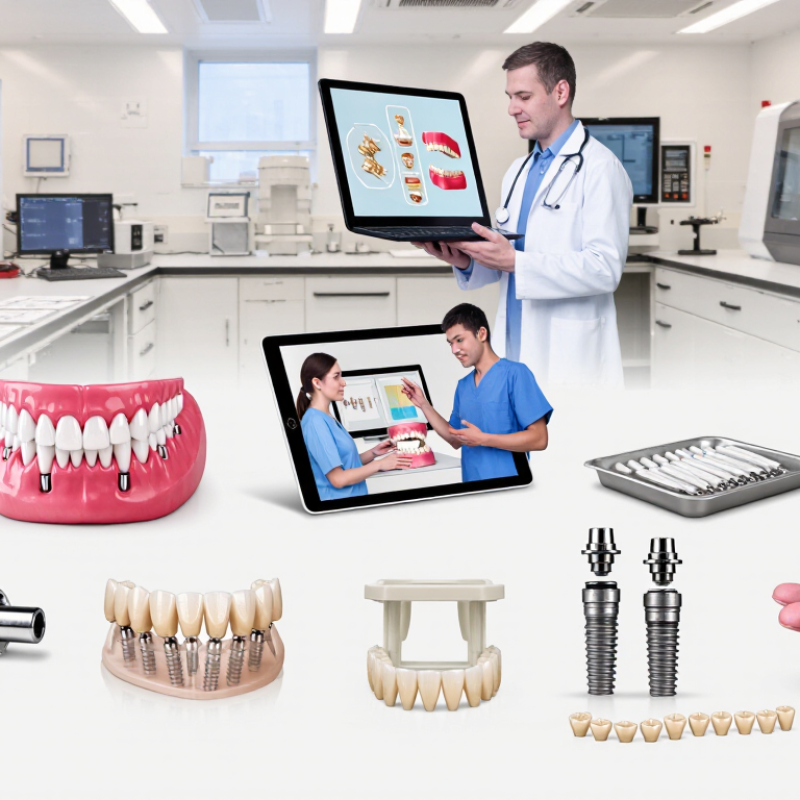
What Are Implant-Supported Dentures?
Implant-supported dentures are removable or fixed prostheses anchored to dental implants. Unlike conventional dentures, they do not rest only on gum tissue. Implants placed in the jaw provide retention, stability, and improved chewing control. An overdenture may use two to four implants, while a fixed design usually needs more support. The correct number depends on bone volume, bite forces, and the patient’s medical history.
The World Health Organization’s Global Oral Health Status Report 2022 identified complete tooth loss as a continuing global health burden, especially among older adults. Clinical evidence also supports implant retention. A long-term review published in Clinical Oral Implants Research reported implant survival rates commonly above 90% over ten years, although results vary by case. These figures should not become promises. Smoking, poor hygiene, uncontrolled diabetes, and insufficient bone can reduce predictability.
In practice, treatment begins with three-dimensional imaging, digital planning, and a detailed examination of the gums. The final denture should feel stable during speech and chewing, not merely look natural in a photograph. Patients may need bone augmentation or a healing period before loading. Maintenance remains essential, including professional cleaning and checking the attachment components. Small parts can loosen. That detail is easy to overlook. When comparing suppliers, dental professionals should verify material documentation, manufacturing consistency, fit accuracy, and technical support. A cheaper component may create higher adjustment costs later.
China Top 10 Implant Supported Dentures Suppliers? - What Are Implant-Supported Dentures?
Implant-supported dentures are removable or fixed dental prostheses stabilized by dental implants rather than relying only on natural suction, adhesive, or adjacent teeth. The following table summarizes commonly supplied restoration configurations and the main specifications buyers should evaluate. Implant numbers and treatment suitability are general clinical ranges and must be confirmed by a qualified dental professional.
| No. | Restoration Configuration | Typical Implant Range | Retention Method | Removability | Common Framework or Base | Main Advantages | Key Evaluation Point |
|---|---|---|---|---|---|---|---|
| 1 | Mandibular Two-Implant Overdenture | Usually 2 implants in the anterior mandible | Stud attachments or a short bar | Removable by the patient | Acrylic denture base with replacement teeth | Improves mandibular denture stability and chewing comfort | Attachment wear, implant spacing, hygiene access, and repair support |
| 2 | Mandibular Four-Implant Overdenture | Commonly 4 implants distributed across the arch | Bar, stud, or locator-style attachments | Removable by the patient | Acrylic base; metal or high-strength framework may be added | More retention options and load distribution than a two-implant design | Passive fit, implant parallelism, attachment maintenance, and space for hygiene |
| 3 | Maxillary Implant Overdenture | Often 4 to 6 implants, depending on bone and design | Usually a bar or multiple individual attachments | Removable by the patient | Acrylic base, sometimes reinforced with a cast or milled framework | Can improve retention while allowing prosthesis removal for cleaning | Implant distribution, palatal coverage requirements, speech, and hygiene design |
| 4 | Bar-Retained Overdenture | Commonly 2 to 6 implants, based on arch and bar design | A custom or prefabricated bar with clips or riders | Removable by the patient | Acrylic denture with metal reinforcement and clip housings | Strong splinting effect and predictable retention when accurately fabricated | Bar passivity, vertical space, clip replacement, and cleaning beneath the bar |
| 5 | Stud-Attachment Overdenture | Usually 2 to 4 implants in the mandible; more may be used in the maxilla | Individual male-female attachment units | Removable by the patient | Acrylic base with replaceable polymer inserts | Straightforward component layout and relatively easy laboratory processing | Attachment angulation, insert retention, wear resistance, and replacement availability |
| 6 | Screw-Retained Full-Arch Fixed Prosthesis | Commonly 4 to 6 implants per arch | Prosthesis screws connected to multi-unit abutments | Removable only by a dental professional | Acrylic teeth and base over a metal or high-strength framework | Fixed feel, retrievability for professional maintenance, and reduced palatal coverage | Framework passivity, screw access, occlusion, hygiene contours, and repair protocol |
| 7 | Milled-Bar Fixed-Detachable Prosthesis | Often 4 to 6 implants per arch | Precision-milled bar with screws or auxiliary retention | Clinician-removable | Milled metal or high-strength framework with acrylic or composite teeth | Rigid support, precise fit, and access for professional service | CAD/CAM accuracy, framework material, passivity, tissue clearance, and serviceability |
| 8 | Monolithic High-Strength Full-Arch Prosthesis | Typically 4 to 6 implants per arch | Screw-retained through multi-unit abutments | Clinician-removable | Milled or pressed high-strength ceramic or polymer framework, depending on the design | Fewer veneering interfaces and a durable, cleanable surface when properly designed | Material thickness, connector design, occlusal loading, shade stability, and repair options |
| 9 | Immediate Implant-Supported Provisional Denture | Often 4 to 6 implants when immediate loading is clinically appropriate | Usually screw-retained to splinted abutments | Clinician-removable | Reinforced acrylic provisional with prefabricated or digitally designed components | Provides transitional teeth and function during healing and definitive treatment | Primary stability, occlusal control, splinting, adjustment capacity, and documented loading protocol |
| 10 | Digitally Designed Custom Implant Overdenture | Usually 2 to 6 implants, selected according to arch, bone, and retention plan | Digitally planned bar, stud, or other compatible attachment system | Usually removable by the patient | Milled or printed denture base with a metal or polymer reinforcement option | Repeatable workflows, digital records, improved fit control, and easier design revisions | Scanner compatibility, verified implant library, manufacturing tolerances, traceability, and after-sales support |
Related Posts
-
Why Choose Implant Retained Restorations?
-
China Top Partial Denture Solutions for Global Buyers
-
What is Dental Implant Technology and How Does It Work?
-
How to Use Dental Surgical Guides for Precise Implant Placement?
-

How to Choose the Best Smile Restoration Treatments?
-
What Are Full Arch Restorations and Their Benefits for You?